
Strategic Assessment Report on Geopolitical Risks in the Philippines
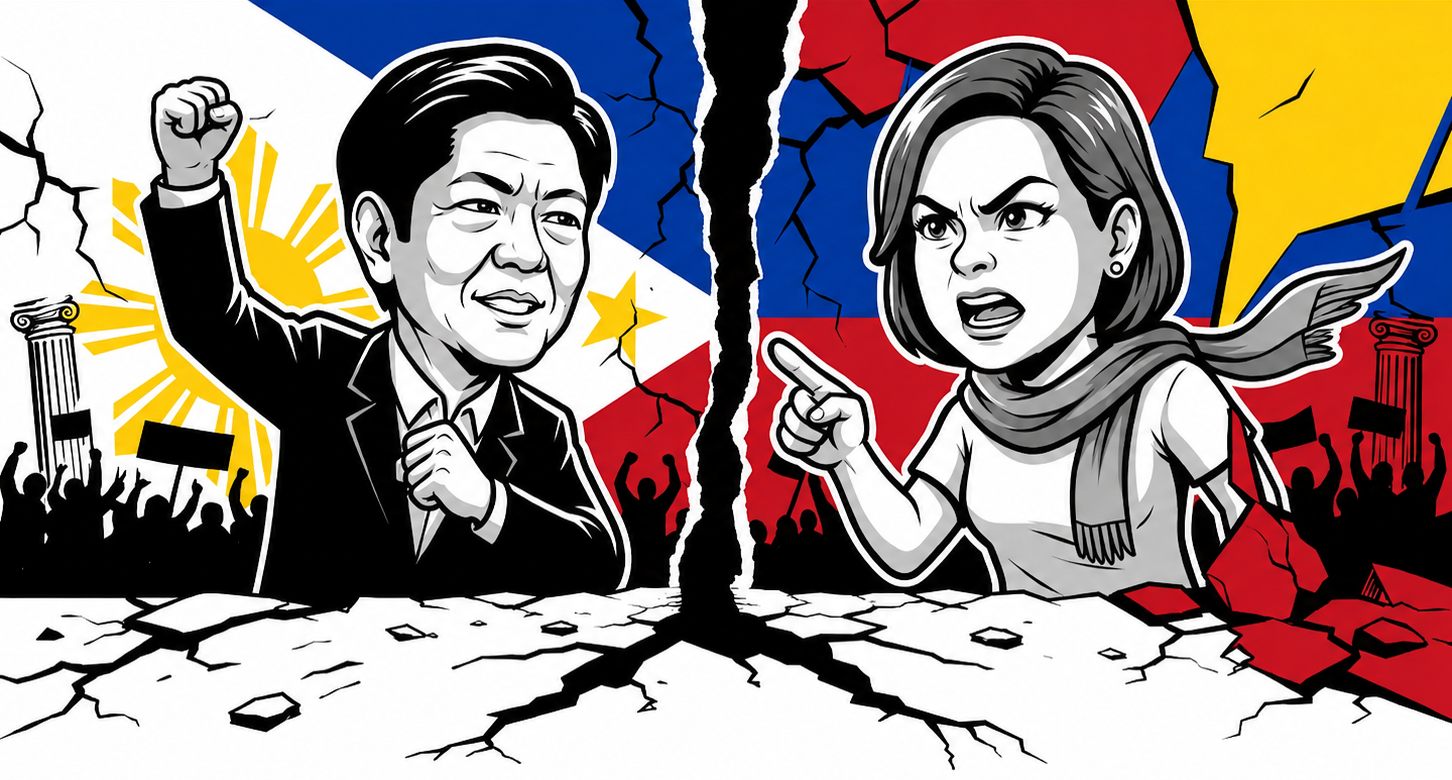
As a representative democracy characterized by the most prominent features of Dynastic Politics in Southeast Asia, the Philippines is currently undergoing its most turbulent political upheaval since the end of the Cold War. In the 2022 general election, the “UniTeam”—composed of the Marcos family, representing the elites of Luzon and the North, and the Duterte family, representing the power blocs of Mindanao and the South—was hailed as the most formidable political cartel in the country’s modern history.
However, from a think-tank perspective using power-patronage modeling, such dynastic alliances based purely on electoral interests naturally lack institutional constraints and a shared ideological foundation; their disintegration was a structural inevitability. Currently, the Philippine political arena is in its most profound realignment since the inception of the 1987 Constitutional framework. The “Unity Alliance” between the Marcos and Duterte families has completely collapsed, evolving into a multi-dimensional struggle spanning judicial, fiscal, institutional, and diplomatic domains. The Marcos administration is employing “Lawfare” tactics—leveraging House impeachment proceedings and external pressure from the International Criminal Court (ICC)—in a concerted effort to neutralize Vice President Sara Duterte’s 2028 succession prospects. Simultaneously, the Charter Change (Cha-Cha) agenda has shifted from an economic narrative toward a calculus of political centralization. Diplomatically, the “Pivot to the West” serves not only as a geopolitical hedge but as a critical lever for the Marcos camp to secure Western political endorsement and consolidate domestic elite rule.
1. Core Issues of Dynastic Conflict: Lawfare and Resource Depletion
The total rupture between the two families is, in essence, an all-encompassing struggle over core national control, fiscal patronage networks, and personal security defenses. The evolution of this conflict has shown a clear upward spiral, eventually solidifying into the current rule-of-law deadlock.
1.1 The “Succession Slot War” and Political Liquidation Risks
In a political system where the “winner takes all” and mature party constraints are absent, losing supreme power often entails ruthless legal and asset liquidation for a family. As the primary potential contender for the 2028 presidential election, Vice President Sara Duterte officially announced her intent to run in February 2026.
To crush the Duterte clan’s plans to return to Malacañang Palace, the Marcos camp (centered around House Speaker Martin Romualdez) has utilized judicial resources to encircle the Duterte faction. The most lethal lever is the ICC investigation into alleged crimes against humanity during former President Rodrigo Duterte’s “War on Drugs.” The Marcos administration’s stance toward the ICC has shifted from early rejection to a “quiet nod” from the Department of Justice (DOJ), or even active enforcement of warrants (such as the one against former police chief and current Senator Bato dela Rosa). This shift is viewed by the Duterte family as a violation of the “life-and-death line” of political trust.
This strategic pivot aims to use external pressure to disarm the Duterte clan, yet it has also caused a marginal impact on the state’s coercive apparatus. Specifically, pro-Duterte factions within the military and police have shown signs of centrifugal tendencies when faced with the pressure of enforcing ICC warrants. The armed standoff within the Senate in May 2026 highlights that judicial sovereignty conflicts have escalated into hard friction between the executive and legislative branches.
1.2 “Surgical Resource Depletion” of Patronage Networks and Fiscal Centralization
The Marcos administration’s encirclement of the Duterte clan is primarily manifested in the redistribution of fiscal power. By stripping the Office of the Vice President and the Department of Education of hundreds of millions of pesos in “Confidential Funds,” the House of Representatives has achieved a surgical strike against the Duterte family’s ability to maintain mobilization in the South and at the grassroots level.
The core of Philippine political maintenance lies in the targeted delivery of central fiscal resources to local dynasties. Within the “Patron-Client” logic, confidential funds serve as the essential lubricant for local dynasties to maintain grassroots loyalty. Through fiscal centralization, the central government has undermined the ability of Mindanao-based power blocs to deliver benefits to their base. This “surgical resource depletion” is not merely a budgetary adjustment but a systemic attempt at dismantling the Duterte network, aimed at exhausting their resources following the 2025 midterm elections and fragmenting their provincial allies.
1.3 Political Calculus of the Senate Impeachment Trial of Sara Duterte
The peak of institutional confrontation between the two families is the joint establishment impeachment faced by Sara Duterte. After a procedural setback where the Supreme Court ruled an initial attempt void, the Marcos-aligned House passed a second impeachment case against Sara, with charges including assassination threats, misuse of confidential funds, unexplained wealth, and bribery.
On May 18, 2026, the Philippine Senate officially convened as an impeachment court. The trial is scheduled to formally commence on July 6, 2026. Since conviction and perpetual disqualification from public office require a two-thirds majority (16 votes) in the Senate, both factions are engaged in intense political lobbying and a high-stakes tug-of-war.
Analysis suggests that a conviction would likely lead to localized unrest or administrative isolation in Mindanao. Conversely, an acquittal would mark a major failure of Marcos’s “Lawfare” strategy, allowing Sara Duterte to rebound strongly as a “victim” in the 2028 elections. This trial represents the first comprehensive judicial reckoning against a sitting Vice President in Philippine history, and its verdict will redefine the constitutional boundaries between the offices of the President and Vice President.
2. Institutional and Constitutional Conflict: Attempts at Centralized Governance
The current Charter Change (Cha-Cha) struggle is key to understanding the transition of the Marcos administration’s governance model from “liberal democracy” toward “technocratic populism/soft authoritarianism.”
2.1 Authoritarian Regression within the 1987 Constitutional Framework
The current 1987 Constitution was drafted following the overthrow of the elder Marcos’s authoritarian rule. Its core design logic is “defensive democracy,” preventing the recurrence of strongman politics by limiting the president to a single six-year term without reelection. However, President Marcos Jr. is achieving a high degree of executive centralization through “legalistic institutional fine-tuning.” This “soft authoritarianism” does not rely on declaring martial law but instead erodes democratic checks and balances through the manipulation of budgets, judicial interpretations, and bureaucratic appointments, all without triggering large-scale “People Power” protests.
2.2 Instrumentalization of Charter Change (Cha-Cha) and “No-El” Scenarios
The Charter Change agenda has transcended its initial economic narrative of “relaxing foreign investment restrictions.” The constitutional amendments pushed by Speaker Martin Romualdez are fundamentally driven by a logic of institutionalized regime extension.
The Marcos administration’s forward-looking intent in pushing for Cha-Cha is to reshape the rules of the power game:
Step 1: Use “Economic Cha-Cha” as a pretext to relax foreign ownership limits in agriculture, public utilities, and media, thereby gaining the trust of foreign capital, industrial conglomerates, and Western allies.
Step 2: Following a stable institutional transition, modify the form of government (e.g., to a parliamentary system or a five-year presidential term with one reelection) to achieve institutionalized executive centralization.
This practice of using “Constitutional Engineering” to weaken political rivals and extend terms of office constitutes a classic feature of soft authoritarianism. Strategic analysis suggests that in a scenario where impeachment might be blocked, Cha-Cha serves as the Marcos camp’s contingency plan. By modifying presidential terms or orchestrating a “No-El” (No Election) scenario for 2028, the ruling coalition seeks to institutionally lock out any possibility of a Duterte comeback.
2.3 Institutional Legitimacy and Social Mobilization in the “Post-Impeachment Era”
The Cha-Cha conflict has simultaneously triggered traditional grassroots mobilization in Philippine society. The Marcos camp has attempted to bypass Senate resistance through the manipulation of a “People’s Initiative”; meanwhile, the Duterte family has retreated to their southern stronghold of Mindanao, even resorting to extreme political slogans like “pushing for Mindanao independence” as leverage against the central government.
This extreme institutional opposition has stripped traditional mediating forces (such as the Catholic Church and business chambers) of their buffering role. Once Cha-Cha enters the Referendum stage, the extreme polarization between the two families could easily evolve into nationwide social fragmentation and mass unrest, thereby shaking the very foundation of the state’s institutional legitimacy.
3. Polarization of Foreign Policy: Internalization of Geopolitics
In the Philippines, foreign policy is often an extension of domestic political interests. The Marcos administration has completely abandoned the “Great Power Hedging” strategy of the Duterte era, shifting toward a comprehensive binding with the US-Philippines alliance. This process exhibits a high degree of “internalization of foreign policy.”
3.1 Deep Binding of the US-Philippines Alliance (EDCA) and Political Arbitrage
The Marcos government has significantly expanded US military access to bases under the Enhanced Defense Cooperation Agreement (EDCA) and normalized trilateral security mechanisms (e.g., US-Japan-Philippines, US-Australia-Philippines). Think-tank analysis suggests this is driven by a need for international endorsement of political legitimacy. Marcos has used this to gain strong backing from Washington, diluting the authoritarian legacy of the Marcos family.
This strategic arbitrage reached a milestone during the “Balikatan 2026” large-scale joint military exercises in April and May 2026. Mobilizing over 17,000 multinational troops, the exercise saw the Japanese Self-Defense Forces and other allies transition from “observers” to “multi-dimensional participants.” By high-profilely leading this landmark military action—viewed as a “simulation of defending against external invasion”—Marcos directly converted EDCA security assets into legitimacy capital for his domestic confrontation against Duterte’s “pragmatic pro-China” line.
Furthermore, this symbolizes the economic feedback of security assets. Marcos is attempting to trade “geopolitical security assets” for substantial economic support from the US and its allies. The calculus is to leverage the “tribute” of EDCA bases and high-spec joint exercises to deeply bind the Philippines to US-Japan strategic supply chains under the “Luzon Economic Corridor” framework. The core goal is to secure Western direct investment in clean energy, semiconductor supply chains, advanced drone technology, and critical infrastructure, thereby filling the funding vacuum left by stalled Chinese-backed projects (such as the Subic-Clark Railway). However, the conversion rate of this strategy remains highly dependent on Western capital’s cautious attitude toward Philippine domestic infighting and high energy costs.
3.2 Nationalist Mobilization in the South China Sea and the Risk of Escalation
The Marcos administration has adopted a high-profile “Grey Zone” transparency strategy in the South China Sea (e.g., Ayungin Shoal/Second Thomas Shoal, Scarborough Shoal), allowing real-time media broadcasts of maritime frictions. In domestic logic, this shrill nationalist narrative serves as an excellent “political shield,” effectively diverting public anger from domestic failures like food inflation and energy shortages, while labeling the pragmatic pro-China Duterte camp as “traitors” or “proxies.”
However, this total internalization and “entertainmentization” of diplomatic issues face a risk of losing control, leading to a historic cooling of China-Philippines relations. In the absence of a mature Crisis Management Mechanism, frequent frontline frictions are approaching the “tripwire” of Article IV of the Mutual Defense Treaty (MDT), pushing the Philippines to the forefront of a geopolitical conflict.
3.3 “Hardline on China” and Resistance in Local Political Economy
Marcos’s “total pro-US” line is encountering structural resistance in the Local Political Economy. Some provinces in Northern Luzon, due to their proximity to the Taiwan Strait, have expressed deep concern over becoming US frontline bases and being dragged into a Great Power conflict. Simultaneously, Southern Mindanao and some agricultural provinces, facing the loss of access to Chinese markets for bananas and tropical fruits and the suspension of major Chinese-backed infrastructure projects, are growing increasingly resentful. The “spatial imbalance of interests” in foreign policy is injecting new catalysts into the dynastic struggle, providing the Duterte camp with a populist narrative of “protecting local interests.”
4. Macro Risk Assessment and Trend Outlook
Based on the structural analysis above, this think tank proposes two possible Scenario Analyses for the political evolution of the Philippines over the next 2-3 years, along with a comprehensive Risk Matrix.
4.1 Scenario Analysis for 2026-2028
Scenario A: “Authoritarian Establishment Victory” for the Marcos Camp
Triggers: The Senate impeachment trial beginning in July 2026 concludes with a 2/3 majority conviction of Sara Duterte, leading to her removal and disqualification; the Supreme Court allows the ICC warrant to proceed, completing the physical removal of the Duterte core; Economic Cha-Cha narrowly passes in a referendum.
Outlook: The Duterte family’s political assets at the national level face destructive liquidation, retreating into pure local warlordism. The Marcos family and their allies monopolize national power for a phase. However, with the “common enemy” gone, the Marcos court will quickly fall into a new round of infighting between the Marcos and Romualdez families over the 2028 presidential election, and national governance efficiency will fail to fundamentally improve.
Scenario B: Normalization of Judicial Deadlock and “Soft Civil War”
Triggers: The Senate fails to cross the 2/3 impeachment threshold, and Sara survives; or the impeachment passes but triggers large-scale tax resistance and defiance movements in Mindanao; factional struggles within the military and police become overt, and ICC warrants trigger localized armed standoffs between security forces.
Outlook: The Philippines will fall into total political functional paralysis. National administrative resources will be entirely consumed by endless political bickering, and the government will lose the ability to implement counter-cyclical adjustments and structural economic reforms.
4.2 Strategic Risk Matrix
For external investors and geopolitical observers, this think tank provides a multi-dimensional rating of the Philippines’ current core indicators:
| Assessment Dimension | Risk Rating | Core Observation Indicators | Think-Tank Strategic Viewpoint |
| Political Stability | High | Progress of the July Senate Impeachment Court; Personnel changes in high-level military/police; Mass incidents in the Davao region. | The Philippines has entered a “high noise” period. While the probability of a traditional large-scale military coup is low, the exhaustion of rule-of-law credibility due to Lawfare has brought political stability to its lowest point since the end of the Cold War. |
| Regulatory Predictability | Medium-High | Referendum on foreign investment restrictions; Realization rate of replacement funding for Chinese-backed projects; Inflation and sovereign credit ratings. | Despite aggressive investment promotion, political infighting has led to a severe degradation of administrative efficiency. The risk of project suspensions and unilateral contract re-evaluations (policy reversals) due to foreign policy polarization has surged. Supply chains must factor in a high “political uncertainty premium” and extreme energy costs. |
| Geopolitical Spillover | High | Frequency of grey-zone conflicts in disputed waters; US-Philippines joint exercises and Chinese countermeasures. | The South China Sea issue has been highly mobilized as a legitimacy tool for domestic politics. Under the pressure of domestic needs, the Marcos government has little room for policy retreat. The probability of a localized friction spiraling out of control and triggering the MDT is at a historic high. |
Note: This report is based on public data and strategic modeling as of May 2026 and does not constitute direct investment advice.


 Malay
Malay  English