
1. Executive Summary
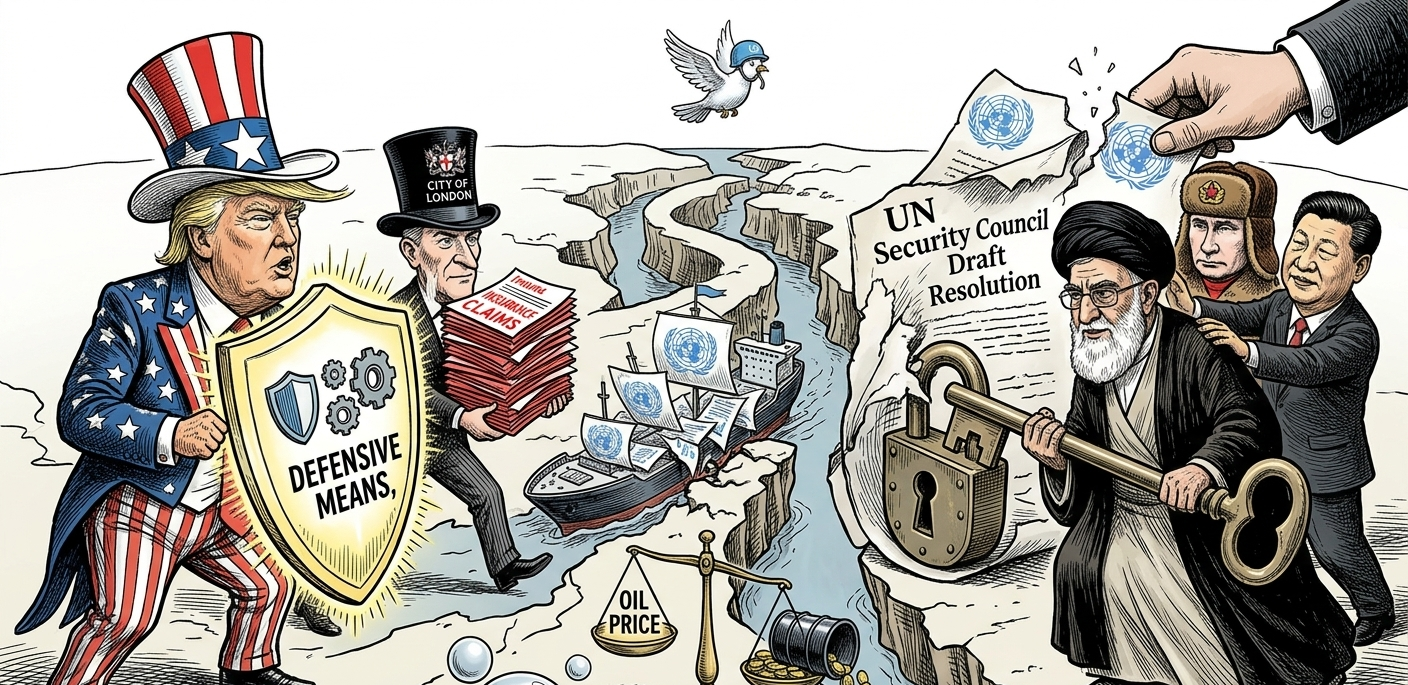
This report provides an in-depth analysis and assessment of the United Nations Security Council (UNSC) draft resolution led by Bahrain and strongly pushed by the United States, the United Kingdom, and the Gulf Cooperation Council (GCC) to ensure freedom of navigation in the Strait of Hormuz. The core of this draft lies in the introduction of the term “defensive measures,” a phrase intentionally left with ambiguous space, attempting to reshape the international transit rules of the strait. Currently, as a global critical energy corridor, the Strait of Hormuz faces unprecedented tension due to the conflict between Iran and the U.S.-Israel alliance.
The report details the linguistic evolution of the draft from the initial “all necessary measures” to the revised “all necessary defensive measures” and analyzes the complex positions and underlying geopolitical and national interest considerations of the P5 members (U.S., Russia, China, France, and the UK). It assesses the probability of Russia and China exercising their veto power and the profound impact this would have on the resolution’s effectiveness. Furthermore, it explores whether the passage of the resolution would provide international legal legitimacy for military actions taken by the U.S. and Israel in the strait. Simultaneously, the report analyzes Iran’s strong opposition and its potential responses. Through scenario analysis of three future paths (veto, watered-down passage, and diplomatic breakthrough) with probability assessments, this report aims to provide comprehensive policy recommendations for decision-makers to maintain international freedom of navigation while avoiding further escalation of regional conflict and promoting long-term stability in the Middle East.
2. Background and Evolution of the Draft Resolution
2.1 Sponsors and Motivations
The draft resolution was co-sponsored by Bahrain on behalf of the Gulf Cooperation Council (GCC) member states and Jordan. The core motivation is to counter Iran’s “effective blockade” strategy in the Strait of Hormuz. According to GCC reports, Iran’s blockade has removed approximately 400 million barrels of crude oil (equivalent to about 4 days of global supply) from the market, directly triggering a surge in global oil prices. This economic shock not only affects the energy export revenues of GCC countries but also poses a serious threat to global economic stability. The GCC states believe Iran’s actions severely violate their sovereignty and territorial integrity and call upon the Security Council to assume its responsibility for maintaining international peace and security by protecting maritime routes.
2.2 Core Objectives and Time Constraints
The draft aims to strip Iran of its asymmetric control, forcibly terminating the “selective navigation” and unilateral security screenings currently implemented by Tehran, and restoring the freedom of “transit passage” as stipulated by the United Nations Convention on the Law of the Sea (UNCLOS). More importantly, it seeks to provide endorsement for military legalization, authorizing multinational navies to establish normalized patrol and interception mechanisms in the strait and adjacent waters to deter any attempts to interfere with commercial shipping.
The initial authorization period set by the draft is 6 months. This short-term design is intended to lower the guard of countries like China and Russia, suggesting it is a temporary wartime transitional measure to address the current crisis. However, the ambiguity of key phrasing essentially lays the groundwork for subsequent indefinite extensions.
2.3 Key Provisions and Linguistic Disputes
The core of the draft resolution lies in the provisions authorizing states to take action to ensure freedom of navigation, but its wording has undergone significant evolution, reflecting the intense maneuvering among P5 members:
2.3.1 Initial Wording: “All Necessary Measures”
The original version of the draft authorized states to take “all necessary measures” to ensure freedom of navigation in the Strait of Hormuz. In the context of the UNSC, this phrase is typically interpreted as an authorization for the use of force under Chapter VII of the UN Charter. This means that if the draft were passed with this wording, it would provide a broad international legal basis for military intervention by the international community (particularly the U.S. and its allies), including but not limited to military escorts, clearing obstacles, and even military strikes against entities threatening shipping.
2.3.2 Revised Wording: “All Necessary Defensive Measures”
Due to severe disagreements among P5 members, especially explicit opposition from Russia, Bahrain revised the draft. The updated version changed “all necessary measures” to “all necessary defensive measures” or “all defensive means proportionate to the circumstances.” This modification aims to limit the scope of authorization and avoid being interpreted as a blanket mandate for offensive military operations. Supporters argue this move reduces the risk of military escalation while still providing a legal basis for states to take self-defense actions. However, critics point out that the definition of “defensive” remains ambiguous in practice, leaving room for interpretation regarding military operations.
2.4 Current Status and Timing
The vote on the draft resolution has been postponed to early April 2026, primarily because P5 members failed to reach a consensus on the wording. This delay itself reflects the profound divisions and complexity within the international community regarding how to respond to the Strait of Hormuz crisis. The failure of the Security Council to pass the resolution quickly indicates obstacles to unified international action, which may bring uncertainty to the further evolution of the regional conflict.
3. The P5 Position Spectrum and Underlying Logic
The attitudes of the five permanent members of the UNSC (U.S., Russia, China, France, and the UK) toward the draft resolution deeply reflect their respective national interests, geopolitical strategies, and differing interpretations of international law principles.
3.1 United States: Support and “Peace Through Strength”
The U.S. strongly supports the draft resolution, viewing it as an effective tool to restore maritime security in the Strait of Hormuz and exert pressure on Iran. The Trump administration adheres to its signature “Peace Through Strength” philosophy, attempting to force Iran into concessions at the negotiating table by demonstrating overwhelming military power and securing international authorization. The passage of the draft, especially if it retains the “all necessary measures” wording, would provide international legal legitimacy for the U.S. and its allies to act in the strait, thereby reducing the political costs and international condemnation of their actions. Even with the “defensive measures” wording, the U.S. might interpret it as authorization for preemptive or punitive strikes against any “threats” in the strait to protect its allies and its own interests in the Gulf region.
3.2 United Kingdom: The Staunch Supporter
Beyond the traditional U.S.-UK special strategic alignment, London’s core interests as the absolute center of the global maritime insurance industry (such as Lloyd’s of London) are under fatal threat. Iranian harassment has caused the “War Risk Surcharge” in the Persian Gulf to skyrocket exponentially. If the strait remains under asymmetric blockade in a “gray zone,” the UK’s financial and reinsurance sectors face systemic bad debt risks in the trillions. Therefore, the UK’s defense of freedom of navigation on the high seas is, in essence, a defense of its national financial lifeline.
3.3 France: The Drifter
French Ambassador Jérôme Bonnafont has called for “defensive measures that avoid the broad use of force.” France does not wish to see energy corridors cut off but is extremely wary of “poison pill” provisions in the draft that could greenlight military operations. France advocates for diplomatic cooling through the European-led “EMASoH” (European Maritime Awareness in the Strait of Hormuz) escort mechanism, avoiding being completely tied to the U.S.-Israel war machine.
3.4 Russia: Explicit Opposition and Sovereignty Concerns
Russia holds a clear opposing stance on the draft resolution. Foreign Minister Sergey Lavrov publicly stated that the draft “cannot be approved” as it does not contribute to a peaceful resolution and could instead lead to a broad escalation in the use of force. Russia believes that even the revised “defensive measures” wording could be abused to violate Iranian sovereignty and exacerbate regional tensions. Russia has consistently opposed any UNSC resolution that could be used by Western nations as a pretext for interfering in internal affairs or authorizing unilateral military action. In the S/RES/2817 resolution passed on March 11, 2026 (condemning Iranian strikes), Russia abstained, further indicating its high level of caution and opposition to any military authorization targeting Iran. Russia’s position aims to maintain its geopolitical influence in the Middle East and avoid providing legitimacy for U.S. military actions in the region. Additionally, in the macro context of the Russia-Ukraine conflict and global competition, Moscow is content to see U.S. forces continuously drained in the Middle East quagmire. Any UNSC resolution that weakens the resistance capability of its quasi-ally Iran will face strategic counteraction from Russia.
3.5 China: Aligned with Russia and Non-Interference
China typically maintains a similar position to Russia in the Security Council, especially on issues involving sovereignty and the principle of non-interference. China is likely to hold reservations about any resolution authorizing the use of force (even “defensive” force), fearing it could be abused and escalate regional conflict. China has long emphasized resolving international disputes through dialogue and negotiation, opposing unilateralism and the threat of force. In the S/RES/2817 resolution, China also abstained, suggesting it is highly likely to take a similar stance—either abstaining or voting against—on the current draft to avoid providing a legal basis for military actions that could lead to regional instability. China’s primary considerations are maintaining the authority of international law, avoiding setting a precedent for major powers to interfere in internal affairs, and protecting its economic interests in the Middle East, particularly the stability of energy imports.
4. The Veto Dilemma & Res 377
Given the high probability of China and Russia (especially Russia) exercising their veto power, the draft is highly unlikely to pass at the Security Council level. If the draft is vetoed, the most direct and profound impact is that the UNSC will be unable to reach a consensus on the Strait of Hormuz issue or authorize any military action. This means that if the U.S. and its allies wish to take military action to maintain freedom of navigation, they will lack the legal endorsement of the UNSC. However, the U.S. and UK have prepared sophisticated legal contingencies:
4.1 UN General Assembly Resolution 377(V) (“Uniting for Peace”)
If the Security Council is paralyzed by a permanent member’s veto, the U.S. and UK could push to move the issue to the General Assembly by invoking Resolution 377(V), passed in 1950 (Uniting for Peace). This resolution explicitly states that if the Security Council fails to exercise its primary responsibility for maintaining international peace, the General Assembly has the authority to convene an “Emergency Special Session” within 24 hours to make recommendations to members for collective measures, including the use of force. While General Assembly resolutions lack the “legal binding force” of Security Council resolutions, they provide unparalleled global political legitimacy and a moral high ground.
4.2 “Coalition of the Willing”
If political endorsement is obtained through GA Resolution 377, the U.S., UK, and GCC (Saudi Arabia, UAE, etc.) would bypass the Security Council to form a de facto multinational escort coalition. This “Coalition of the Willing” would use the GA resolution as a moral banner to conduct mandatory escorts in the strait, leading to direct maritime friction with Iran’s Islamic Revolutionary Guard Corps (IRGC). However, this would face severe international legal scrutiny and could be viewed by the international community as unilateralism, thereby weakening U.S.-led international leadership.
5. Dialectical Focus: Will the Draft Provide “Legalization for War” for the U.S. and Israel?
Even if the draft resolution passes with the “all necessary defensive measures” wording, its impact on the legalization of U.S. and Israeli military actions remains a core point of contention. In international relations and the law of armed conflict, the definition of “defensive” is often elastic and easily interpreted by parties according to their own interests. The U.S. and Israel might interpret it as authorization for preemptive or punitive strikes against any “threats” in the strait to protect shipping security and regional interests. For example, under modern laws of war, the U.S. and Israel could easily interpret “clearing Iranian shore-based anti-ship missile sites” or “destroying fast-attack craft home ports on Qeshm Island” as “preventive defensive measures taken to ensure navigation safety.” This means that even if the resolution’s original intent is defensive, it could be used in practice by the U.S. and Israel as a legal shield for expanding the scope of strikes, or even conducting surgical bombings on the Iranian mainland.
Such an interpretation would blur the line between self-defense and aggression in international law and could set a dangerous precedent for future unilateral military actions. Through a UNSC resolution, even if the wording is watered down, it could be seen as a form of international acquiescence to specific actions, providing “legal” cover for U.S.-Israeli military intervention politically and morally. This would make it harder for the international community to effectively constrain and condemn U.S.-Israeli military actions in the strait in the future.
6. Iran’s Attitude and Response to the Draft Resolution
Iran views the draft resolution as a severe violation of its sovereignty and a “trap” for further military intervention by the U.S. and Israel. Tehran maintains that the Strait of Hormuz lies within its territorial waters and that its “supervision” and management of the strait are manifestations of its sovereign rights. Any attempt by external powers to interfere with its control over the strait through a UN resolution will be viewed as a direct threat to its national security.
Iran has explicitly stated that it will continue to “supervise” shipping in the Strait of Hormuz and has threatened to respond to any “defensive measures” it deems a direct violation of its sovereignty. Such responses could include:
•Strengthening Military Deployment: Deploying more anti-ship missiles and naval forces at key strategic locations such as Qeshm Island.
•Asymmetric Warfare: Using fast-attack craft, sea mines, and drones to harass or attack passing vessels to test the limits of the international community’s reaction.
•Diplomatic Counter-offensive: Strongly condemning the resolution at the UN and other international venues to gain understanding and support for Iran’s position.
•Stirring Domestic Nationalist Sentiment: The Iranian regime may use external pressure to portray the passage (or attempted passage) of the draft resolution as a threat to national security by external forces, thereby further consolidating internal unity and diverting domestic contradictions.
7. Scenario Analysis: Future Developments of the Draft
Scenario analysis of the subsequent developments of the UNSC draft resolution helps assess the possible directions of the regional situation and its impact on all parties.
Scenario 1: Draft Vetoed (High Probability)
Given that Russia has explicitly expressed opposition and China is likely to take a similar stance, the probability of the draft being vetoed is extremely high.
Impact Analysis:
•International Law and UN Authority: The failure of the Security Council to reach a consensus on the Strait of Hormuz will further weaken the UN’s authority and effectiveness in handling major international crises. The limitations of international law in constraining the behavior of major powers will be highlighted once again.
•Legitimacy of U.S.-Israeli Actions: If the U.S. and its allies take military action, they will lack the legal endorsement of the UNSC. This may prompt them to form a “Coalition of the Willing” for intervention, but their actions will face severe international legal scrutiny and could be viewed as unilateralism, drawing broader international condemnation.
•Regional Tensions: Military actions lacking international consensus could exacerbate regional tensions, increasing the risk of direct military conflict. Iran will have more reason to view any external military action as an illegal invasion and take tougher counter-measures.
•Global Energy Markets: Uncertainty in strait shipping will persist, global energy markets will continue to fluctuate, and oil prices may remain high or even rise further.
Scenario 2: Watered-down Wording, Draft Passed (Medium Probability)
If the U.S. and its allies are willing to make greater concessions and further water down the wording to secure abstentions from China and Russia, the draft might still pass.
Impact Analysis:
•International Law and “Defensive” Interpretation: The resolution passes but only authorizes “defensive measures” with strict limits on the use of force. However, the definition of “defensive” remains ambiguous in practice, and the U.S. and Israel might interpret it as authorization for preemptive or punitive strikes against any “threats” in the strait. This will trigger ongoing disputes over the boundaries of “defensive” actions.
•Legitimacy of U.S.-Israeli Actions: Provides limited international legal basis for the U.S. and its allies, but their actions may still face scrutiny and questioning from the international community. Iran may continue to employ asymmetric strategies, keeping the regional conflict in a state of low-intensity war of attrition.
•Iran’s Response: Iran may continue asymmetric strategies, using fast-attack craft, mines, and drones to harass or attack vessels to test the international community’s limits. Simultaneously, Iran will continue to condemn the resolution diplomatically and use nationalist sentiment to consolidate its regime.
•Global Energy Markets: Markets may stabilize slightly in the short term, but long-term uncertainty remains due to the potential escalation risks of “defensive” actions.
Scenario 3: Diplomatic Breakthrough (Low Probability)
Given the current hardline positions of all parties and the lack of effective trust-building mechanisms, achieving a diplomatic breakthrough in the short term is difficult.
Impact Analysis:
•Regional Tensions: Through the joint efforts of P5 members and regional powers (such as Oman and Qatar), parties reach some form of de-escalation agreement, such as establishing a maritime security dialogue mechanism or pledging not to take unilateral military action. Regional tensions ease, and shipping in the Strait of Hormuz returns to normal.
•International Cooperation: A diplomatic breakthrough would enhance the role of the UN and regional organizations in crisis resolution, promoting international cooperation and multilateralism.
•Long-term Solutions: However, even if a de-escalation agreement is reached in the short term, deep-seated contradictions in the Middle East (such as the Iranian nuclear issue and regional proxy conflicts) remain unresolved. Long-term solutions still require arduous negotiations within a broader regional security framework.
•Global Energy Markets: Market confidence will recover significantly, oil prices will stabilize, contributing to global economic recovery.
8. Policy Recommendations
In response to the current volatile and dangerous situation, this think tank proposes the following three fully operational recommendations to neutral countries (such as those in East Asia, Latin America, and parts of Europe) and the UN Secretariat:
Recommendation 1: Promote the Establishment of a “Strait of Hormuz Neutral Green Channel” Mechanism
Given Iran’s “selective navigation,” neutral countries should jointly promote the establishment of a clearly marked “Green Neutral Channel” led by the UN International Maritime Organization (IMO).
Implementation Steps: Lobby Iran to allow civilian commercial vessels flying neutral flags and insured by non-Western insurance companies (which could be jointly established as an emergency mutual insurance fund by neutral countries) to pass without harassment after electronic verification by IMO third-party neutral observers. This move aims to physically isolate “commercial transit” from “geopolitical military” issues.
Recommendation 2: Launch “Reverse Diplomacy” with GCC-led “Asia-Gulf” Closed-door Dialogues
Since the U.S. and Israel have no room for retreat, the key to breaking the deadlock lies with Saudi Arabia and the UAE.
Implementation Steps: Major energy-consuming countries in Asia should join the EU in holding closed-door consultations with Saudi Arabia and the UAE. Clarify to them: once the U.S.-UK coalition uses force in the strait, GCC desalination plants and oil terminals will inevitably be the first to face Iranian saturation strikes. This would pressure GCC countries to urge the U.S. to delay pushing the radical draft before the UNSC vote, and instead have Oman lead a new round of ceasefire mediation.
Recommendation 3: UN Secretary-General Urgently Activates the “Preventive Diplomacy” Special Envoy Mechanism
Before the Security Council vote, the UN Secretary-General should proactively appoint an emergency special envoy to the Persian Gulf under Article 99 of the UN Charter.
Implementation Steps: The envoy should be based in Muscat, Oman, establishing a “24-hour emergency hotline without preconditions” among the U.S., Israel, and Iran. This mechanism does not aim for permanent peace but focuses solely on “crisis explosion prevention”—providing an underground communication channel for rapid clarification in the event of accidental strikes or miscalculations to avoid a spiral of escalation.


 English
  Malay
Malay