
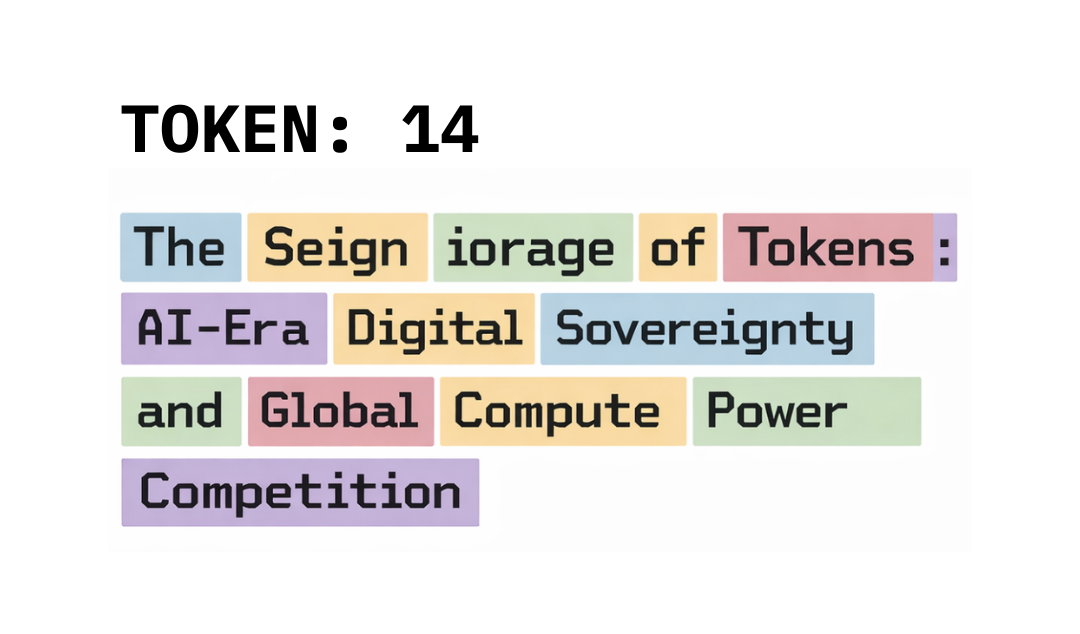
1. Executive Summary
In the global economic landscape of 2026, Artificial Intelligence (AI) has evolved from a technical auxiliary tool into a core engine driving growth. This report introduces the core analytical framework of “Token Seigniorage” to reveal the deeper logic of power distribution in the AI era. Tokens (lexical units), as the smallest unit of intelligent output, are gradually acquiring value-anchoring and circulation attributes similar to traditional fiat currencies.
The report highlights that global tech giants (Hyperscalers), through their extreme monopolization of compute power, talent, and energy, are constructing a “digital coinage system” independent of the traditional financial system. This concentration of power not only reshapes the profit distribution across global industrial chains but also triggers intense competition for “compute sovereignty” among the US, China, Europe, and the Middle East. This report will deeply analyze this process and provide strategic recommendations for policymakers to address future “intelligent inflation” and “compute hegemony.”
2. Chapter 1: Token Economics – “Digital Gold” and “Seigniorage” in the AI Era
2.1 From “Bits” to “Tokens”: The Evolution of Value Metrics
In the internet era, information flow was measured in “bits,” and value was primarily reflected in connectivity and distribution. However, in the AI era, value creation shifts to the “generation of intelligence.” Tokens (lexical units), as the fundamental units for large language models to process text, images, and multimodal data, have become the sole standard for measuring the scale and quality of intelligent output.
| Dimension | Traditional Monetary System (Fiat Currency) | Token Economic System (AI Token) |
| Value Anchor | National Credit / Gold Reserves | Compute Density / Energy Consumption / Model Intelligence |
| Issuing Authority | Central Banks | Model Providers (Hyperscalers) |
| Unit of Circulation | Fiat Currency (USD, CNY, etc.) | Token (Lexical Unit) |
| Source of Seigniorage | Seigniorage from currency issuance | Difference between compute cost and API pricing |
2.2 The Modern Definition of “Seigniorage”: Pricing and Distribution of Intelligence
“Seigniorage” in the AI context has been endowed with a new meaning. It is no longer merely the right to print money but refers to the ability to determine the global allocation sequence of intelligent resources by controlling the core elements (compute power, energy, data) that produce Tokens.
Players who hold Token seigniorage effectively control the “admission ticket” to the future digital society. Whether it’s autonomous driving, biopharmaceuticals, or financial decision-making, all AI-dependent industries must pay an “intelligence tax” to the seigniorage holders. This tax exists in the form of API call fees, which are essentially the difference between compute costs and the premium for intelligence.
2.3 Why are Tokens the “New Currency”?
Tokens possess the three basic functions of money:
1.Measure of Value: Complex cognitive tasks can now be precisely quantified as “how many millions of Tokens were consumed.”
2.Medium of Exchange: Through API interfaces, Tokens are crossing national borders and industries, becoming the universal settlement unit for digital services.
3.Store of Value: High-quality pre-trained models and fine-tuned private models are essentially “solidified” Token production capabilities that can be invoked at any time, possessing extremely high asset attributes.
With NVIDIA’s “tiered pricing for inference market” strategy introduced at GTC 2026, the monetary attributes of Tokens are further strengthened. From free basic-tier Tokens to high-end research-tier Tokens priced at $150 per million, a complete “digital monetary hierarchy” is taking shape.
3. Chapter 2: Industrial Chain Landscape – Who is Collecting the “Seigniorage Tax”?
3.1 Upstream: Resources and Tools Layer (Chips, Energy, Foundry)
At the apex of the Token economy are the players providing production tools and raw materials. NVIDIA, TSMC (Taiwan Semiconductor Manufacturing Company), and energy giants constitute the core of this layer.
| Core Player | Role Positioning | Source of Power |
| NVIDIA | Chip design and ecosystem building | Monopoly position of CUDA software stack and Blackwell architecture |
| TSMC | Advanced semiconductor manufacturing | Unique large-scale mass production capability for 2nm/1.4nm processes |
| Energy Giants | Lifeline supply for compute power | Stable, low-carbon nuclear energy and renewable energy quotas |
NVIDIA’s “Hardware Tax”: Through its Blackwell platform, NVIDIA not only maintains hardware performance leadership but also elevates competition from individual chips to a “data center level” through interconnect technologies like NVLink and InfiniBand. By 2026, over 95% of AI developers globally are deeply embedded in NVIDIA’s compute architecture. This extremely high switching cost effectively makes NVIDIA the “first gatekeeper” of Token production.
3.2 Midstream: Infrastructure and Model Layer (Hyperscalers)
This is where the core of Token seigniorage is held. Giants such as Microsoft/OpenAI, Google, Meta, and Amazon/Anthropic exert absolute control over the industrial chain by transforming upstream hardware and energy into consumable “intelligent Tokens.”
Manifestations of Seigniorage:
•Model Definition Rights: They determine the quality standards of Tokens (e.g., GPT-5, Gemini 2.0).
•API Pricing Rights: By dynamically adjusting API prices, they can extract profits from downstream applications at will, or use pricing strategies to squeeze out competitors.
•Infrastructure Monopoly: The training of trillion-parameter models requires tens of thousands of H100/B200 chips. This extremely high capital expenditure (CapEx) barrier excludes most startups from possessing “seigniorage.”
3.3 Downstream: Application and Distribution Layer (SaaS, End Devices, Vertical AI)
Downstream players such as Apple, Salesforce, and Adobe, despite having a massive user base, are highly dependent on midstream suppliers for their underlying architecture.
Power Dynamics: Downstream players are attempting to mitigate cloud-based Token costs through “on-device AI” to some extent, thereby reducing their reliance on midstream giants. However, the limitations of on-device compute mean that complex cognitive tasks still require “taxation” from the cloud.
4. Chapter 3: The Hyperscalers’ Frenzied Competition – Moats and Future Layouts
4.1 Deep Motivations for Seizing the “Three Elements”
In 2026, the total capital expenditure of the four major global tech giants (Alphabet, Microsoft, Amazon, Meta) is projected to exceed $650 billion. This almost frantic investment is not blind; rather, it is a race to secure the “primitive accumulation” of the future intelligent world before the Scaling Law ceases to hold.
•Compute Power (Admission Ticket): The scale of compute power determines the upper limit of Token production. In the 2026 competition, a cluster of one million GPUs has become the standard for top-tier players.
•Talent (Craftsmanship): Top scientists are crucial for optimizing Token production efficiency and reducing per-unit costs.
•Energy (Lifeline): The ultimate frontier of AI is energy. Securing cheap, stable electricity (especially nuclear power) means possessing a long-term cost advantage, as Microsoft and Amazon are massively investing in nuclear energy (SMRs, Small Modular Reactors) to achieve energy self-sufficiency and drive Token production costs to levels unreachable by competitors.
4.2 “Invisible Moats” Beyond Capital
Beyond pouring money, Hyperscalers are building deeper barriers:
1.Data Flywheel: The public internet data is nearing exhaustion. Giants, through their accumulated real-time, private interaction data from search, social media, and office software, have acquired “high-purity ore” for training next-generation models. This data moat cannot be compensated by mere capital investment from any latecomer.
2.Vertical Integration Capability: To reduce reliance on NVIDIA, Google (TPU) and Amazon (Trainium/Inferentia) are accelerating the iteration of their self-developed chips. This full-stack closed loop, from chip design, server assembly, software stack optimization, to end-user applications, enables them to achieve extreme energy efficiency.
3.Developer Ecosystem and API Lock-in: Once a company’s business logic is deeply coupled with a specific vendor’s API, the migration costs become prohibitively high. This “ecosystem stickiness” ensures that the giants have a long-term, stable source of revenue from future Token transactions.
5. Chapter 4: Global Compute Sovereignty Competition – A New Cold War in Geopolitics
5.1 The Rise of Compute Sovereignty (Sovereign AI)
In 2026, compute power is no longer merely a commercial resource; it is regarded by nations as a strategic commodity as vital as oil and food. Major global economies are actively constructing their respective “compute great walls.”
| Region | Core Strategy | Competitive Advantages | Challenges Faced |
| United States | Absolute leadership and export controls | Capital hegemony, top talent, chip design | Aging energy infrastructure, regulatory pressure |
| China | State-led system and full industrial chain | Manufacturing capabilities, vast application scenarios, “East Data West Compute” | Restrictions on high-end chips, uneven compute utilization |
| Europe | Regulation-driven and technological sovereignty | Legal standard-setting power, privacy protection | Lack of local giants, insufficient capital investment |
| Middle East | Energy for compute and capital breakthrough | Extremely low energy costs, sovereign wealth funds | Reliance on core technologies, geopolitical sensitivity |
5.2 Inter-Competition and Game Theory Logic
•US-China “Compute Gap” Tug-of-War:The United States attempts to maintain a “compute gap” with China through export controls, ensuring its absolute lead in Token seigniorage. China, in turn, optimizes its compute layout through the “East Data West Compute” project and accelerates the localization of chips (e.g., Huawei Ascend, Hygon) to pursue “compute self-sufficiency.”
•Middle East’s “Capital for Technology” Strategy:Middle Eastern countries like Saudi Arabia and the UAE, leveraging their extremely low energy costs and vast sovereign wealth funds, have become a “compute hub.” By investing in US and Chinese tech giants, they seek technology transfer and the establishment of localized compute centers, aiming to secure a position in the future AI economy.
•Europe’s “Regulatory Game”:In the absence of indigenous Hyperscalers, Europe attempts to exert regulatory power by defining “compliant Tokens” through legal instruments such as the AI Act. This “regulatory sovereignty” is Europe’s core strategy to protect its digital market and privacy rights in the face of compute power disadvantages.
6. Chapter 5: Conclusions and Policy Recommendations
6.1 Recommendations for Nations
1.Establish “Strategic Compute Reserves”:Governments should integrate compute power into national strategic reserve systems and establish national compute dispatch platforms to ensure the normal functioning of core societal services in extreme circumstances (e.g., supply chain disruptions).
2.Energy and AI Synergistic Planning:Accelerate the application of nuclear energy, SMRs (Small Modular Reactors), and new energy storage technologies in data centers. The essence of AI competition is energy efficiency, and the AI-adaptive transformation of energy structures should be a top priority for industrial policy.
3.Token Value Assessment and Regulatory Framework:Establish national-level standards for Token quality, security, and ethics. Prevent the proliferation of algorithmic bias and misinformation, ensuring that “digital seigniorage” is not abused.
6.2 Recommendations for Enterprises
1.Diversified Compute Layout:Enterprises should avoid vendor lock-in and actively explore the combination of domestic compute power and open-source models (e.g., Llama 4, Qwen 3) to build a more resilient technical architecture.
2.Unlocking Private Data Value:In the Token economy, high-quality private data is the only bargaining chip for enterprises. Companies should strengthen data governance, transforming business logic into trainable, fine-tunable private model assets.
3.Focus on “Edge AI” and Edge Computing:By offloading cloud-based Token costs through edge compute, not only can response speeds be improved, but user privacy can also be effectively protected, building a differentiated competitive advantage.
7. Conclusion
The struggle for “Token Seigniorage” represents one of the most profound economic transformations of the 21st century. It concerns not only the rise and fall of tech giants but also the restructuring of national sovereignty and global order. In this era of intelligent explosion, only by deeply understanding the underlying logic of the Token economy can one stand undefeated in the future compute jungle.



 English
  Malay
Malay