
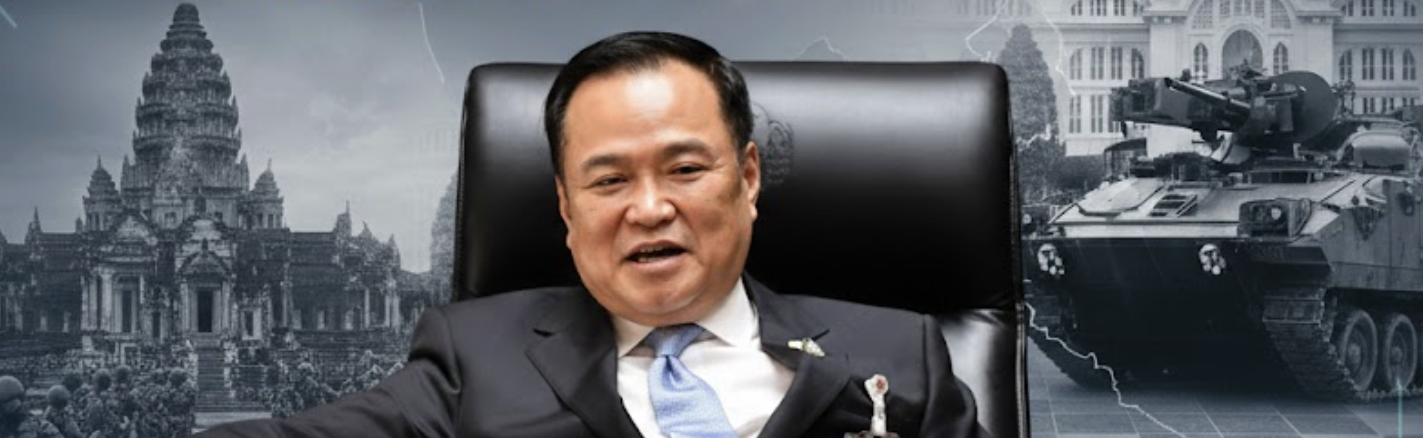
The Thai-Cambodia Conflict, Civil–Military Relations, and the 2026 Election Outlook
Executive Summary
Thai Prime Minister Anutin Charnvirakul’s hardline stance during the Thai–Cambodia border conflict in the second half of 2025 reflects a convergence of domestic political motivations, civil–military relations, and electoral considerations, rather than a response driven purely by border security concerns. This assessment concludes that Anutin’s strategy has been shaped less by immediate tactical developments on the ground than by a broader effort to consolidate political authority ahead of the 2026 general election.
This report analyses the deeper motivations behind the Anutin government’s effective abandonment of the Kuala Lumpur Peace Accord (KLPA), examines his complex relationship with the Thai military, and assesses the challenges he faces heading into the 2026 election, including the potential impact of unresolved personal and family business disputes.
Key Findings
- Politicisation of the Conflict
Anutin’s hardline posture was not driven solely by national security imperatives but constituted a clear electoral strategy. By leveraging militarised nationalist sentiment triggered by the border conflict, he successfully redirected political attention away from his government’s weaknesses on economic management and livelihood issues, while reinforcing his image as a “defender of national sovereignty.”
- Short-Term Boost in Political Support
Although no authoritative nationwide polling data was released immediately after the outbreak of the conflict, available analysis indicates that Anutin and his Bhumjaithai Party benefited from meaningful short-term political dividends. Polling prior to the conflict showed declining support linked to domestic issues such as cannabis, flooding and business scandals, while the conflict created an opportunity for image reversal.
- A “Symbiotic” Relationship with the Military
Anutin’s relationship with the Thai military is not one of subordination but rather a symbiotic political alliance. Bhumjaithai is widely perceived as a pro-military, pro-monarchy party, sharing overlapping interests with the armed forces in preserving national security and traditional political values. The military viewed Anutin’s hardline actions as an opportunity to reassert its central role in national security. Although Anutin is not a military figure himself, his policy alignment increasingly reflects military preferences—particularly on sovereignty, border control, and transnational crime narratives. This convergence appears tactical rather than ideological, aimed at neutralising military opposition during the electoral cycle rather than curbing civilian authority.
- Risks from Personal and Family Business Disputes
Ongoing business disputes involving Anutin and his family enterprises—particularly the Khao Kradong land dispute—represent a persistent vulnerability. Opposition parties are likely to exploit these cases to juxtapose his “national defender” image against allegations of corrupt commercial interests, potentially undermining electoral support.
- Challenges Ahead of the 2026 Election
The principal challenge facing Anutin is the inherently temporary nature of nationalist mobilisation. He must address slow economic recovery and livelihood pressures ahead of the election, while navigating obstruction from major opposition parties (such as Pheu Thai and the People’s Party) and managing the volatility of military backing.
1. Political Motivations and Electoral Calculations Behind the Conflict
1.1 Potential Drivers of Thailand’s Hardline Posture and the Abandonment of the KLPA
The collapse of the Kuala Lumpur Peace Accord was not the result of a single triggering event but rather the outcome of intersecting political, economic, and institutional factors. Available indicators suggest that three drivers were particularly decisive.
1.1.1 Political Image Repositioning and Rising Domestic Pressure
The most immediate driver stemmed from domestic political recalibration. Over the past year, Prime Minister Anutin Charnvirakul and the Bhumjaithai Party faced significant political pressure arising from multiple domestic policy controversies. Most prominent were public backlash against cannabis legalisation, sluggish economic recovery, and rising living costs.
These issues eroded public confidence in governance capacity and exposed the ruling coalition to intensified parliamentary scrutiny, including renewed discussion of no-confidence motions. Against this backdrop, the border conflict provided a critical opportunity to shift domestic political focus and reconstruct leadership image.
1.1.2 Long-Term Economic and National Security Considerations
Beyond short-term political gains, Thailand’s hardline response also rests on genuine long-term economic and security concerns. Thai law enforcement and financial regulators have repeatedly warned that large-scale cyber scam and online fraud networks operating along the Thai–Cambodia border pose a systemic national security threat.
These transnational criminal activities are linked to:
- Large-scale financial losses suffered by Thai citizens
- Infiltration of illicit funds into Thailand’s banking and digital payment systems
- Severe human rights abuses including human trafficking and forced labour affecting Thai and foreign nationals
Official assessments increasingly classify these operations as organised transnational crime networks rather than isolated criminal activity. From this perspective, dismantling scam compounds is seen not merely as political signalling but as a strategic effort to safeguard financial security, social stability, and national credibility—particularly as Thailand seeks to maintain investor confidence and revive tourism.
1.1.3 Structural Deficiencies of the Kuala Lumpur Peace Accord
A third critical factor lies in the institutional limitations of the KLPA itself. From its inception, the accord failed to address the core issue of unresolved border demarcation and competing sovereignty interpretations.
Moreover, the KLPA lacked enforcement mechanisms, monitoring procedures, and third-party verification, rendering it more symbolic than operational. In domestic discourse, it increasingly came to be labelled a form of “symbolic peace,” capable of producing temporary calm but insufficient to prevent renewed conflict.
For nationalist and security-oriented constituencies, unilateral action was framed as a necessary defence of sovereignty rather than a breach of diplomatic commitments—a narrative reinforced by frustration over Cambodia’s perceived failure to curb transnational crime.
1.2 Was the Conflict a Pre-Election Strategy for 2026?
Analysts broadly agree that Anutin’s hardline stance during the border conflict contained a pronounced electoral dimension.
1.2.1 Mobilising Nationalist Sentiment: Border Conflict as Catalyst
Border disputes are highly effective triggers of nationalist sentiment, particularly militarised nationalism. In Thailand’s political context, sovereignty and territorial integrity issues resonate strongly across demographic groups.
a) Rally-Around-the-Flag Effect
Thai political culture features a strong national defence narrative. When external threats emerge, public opinion tends to consolidate behind the government—a phenomenon known as the rally-around-the-flag effect.
In recent years, numerous political events have demonstrated that conflicts in security-sensitive areas—particularly those involving sovereignty and territorial boundaries—often transcend partisan divisions and rapidly consolidate voter support behind the government. For ruling parties or governing coalitions, this dynamic constitutes a politically exploitable reservoir of public sentiment.
b) Differential Appeal Across Voter Groups
- Older and conservative voters view hardline security responses as symbols of state strength.
- Rural and border populations tend to prioritise security stability, translating into higher support for military action.
1.2.2 Securing Military Support: An Institutional and Strategic Convergence
Within Thailand’s political system, the military constitutes a political force that cannot be ignored. Historically, the armed forces have not only functioned as a security institution but have also been a central actor in political contestation. On multiple occasions, the Thai military has played a decisive role during periods of political transition and domestic crisis.
a) The military’s influence over policy choices
Although elected governments formally hold executive authority under Thailand’s constitutional framework, the military retains substantial influence and operational autonomy in matters related to security and defence. As a result, any policy decisions concerning border security and national sovereignty inevitably require consideration of the military’s strategic preferences and institutional interests.
b) Policy alignment as a strategy for securing military support
A defining feature of Anutin’s approach to managing the conflict has been his unconditional support for military operations, both in terms of tactical authorisation and political messaging, with few visible constraints imposed. This posture produces a dual effect in consolidating relations with the military:
Signalling policy alignment: By publicly endorsing military actions, the civilian leadership conveys a clear signal to the armed forces that there is a high degree of convergence on security-related policy objectives.
Reducing the risk of internal friction: In a political system prone to institutional tensions, avoiding open confrontation with the military helps minimise latent sources of instability within the political structure.
c) Practical utility in electoral competition
Military support is not only a pillar of governing stability but also carries electoral value. Should post-election coalition negotiations or cross-factional cooperation become necessary, tacit consent—or at minimum, non-opposition—from powerful military factions can significantly reduce the transaction costs of political bargaining. In this context, policy choices aligned with military interests function as a form of institutional insurance, safeguarding political manoeuvrability in the electoral arena.
2. Public Support Trends Following the Conflict
2.1 Pre-Conflict: Low Approval Ratings and Growing Political Pressure
In the months preceding the outbreak of the conflict, Anutin and the Bhumjaithai Party he leads were generally in an unfavourable position in public opinion polls. Despite formally assuming office as Thailand’s prime minister on 19 September 2025, his political standing was weighed down by multiple domestic issues:
2.1.1 Cannabis policy controversy
Anutin and the Bhumjaithai Party have regarded the legalisation of cannabis implemented in 2022 as a flagship achievement and a core element of their political legacy. Thailand became the first country in Asia to legalise cannabis. However, in practice, the absence of a clear regulatory framework and supporting legislation quickly gave rise to serious problems related to social order, public health, and youth protection, triggering widespread public criticism.
In June 2025, government spokespersons acknowledged that unregulated access to cannabis had caused significant social problems, particularly among children and adolescents. Statistics indicated a marked increase in cannabis use among Thai youth following liberalisation. Local law enforcement agencies were thrown into confusion when dealing with public consumption, nuisance complaints, and odour-related disturbances due to legal ambiguity. These developments severely damaged Anutin’s standing among families and the education sector, and were widely perceived as irresponsible with respect to public health. As a result, the government was forced in mid-2025 to reclassify cannabis flowers as a controlled substance, marking a major policy reversal and weakening Bhumjaithai’s credibility in policy implementation.
More broadly, the policy’s reversals exposed the government’s legislative short-sightedness and lack of professionalism, providing the opposition with ammunition to question its economic governance. Although the cannabis industry was valued at approximately USD 1 billion, policy volatility and regulatory uncertainty—including re-imposition of controls—inflicted significant damage on tens of thousands of businesses dependent on the sector, fuelling dissatisfaction within the business community.
2.1.2 Natural disaster response failures
In late 2025, southern Thailand was hit by severe seasonal flooding. The disaster exposed systemic weaknesses in the Anutin government’s disaster management capabilities, including deficiencies in resource coordination and early warning systems, prompting widespread public criticism of its governing capacity. As of 29 November 2025, the officially confirmed death toll linked to the floods had reached 162. By 28 November, the Emergency Flood Crisis Operation Centre (EFCOC) reported that 145 districts had been affected. The scale of human and material losses translated directly into public anger over the government’s perceived failure to protect citizens, significantly damaging Anutin’s crisis management image.
On 5 December 2025, media reports indicated that the government had failed to deliver effective flood relief to the majority of affected households. Anutin himself acknowledged shortcomings in relief efforts on 29 November. This admission underscored inefficiencies and bureaucratic inertia in central–local coordination and resource distribution, further intensifying doubts about the government’s competence. Given Anutin’s prior tenure as Minister of Public Health and Minister of the Interior, the perceived limits and shortcomings of his governance capacity during the disaster raised broader public questions regarding his leadership capabilities.
2.1.3 Sluggish economic recovery
Although Thailand’s economy continued to recover throughout 2025, the pace of recovery remained slow and uneven. Inflationary pressures, sluggish income recovery, and persistently high living costs continued to weigh public perceptions of economic well-being, preventing the Anutin government’s economic policies from gaining broad public endorsement. While Thailand’s Consumer Price Index (CPI) declined year-on-year by 0.76% in October 2025 and by 0.5% in November—nominally indicating deflation—this trend was largely driven by government subsidies and falling energy prices. Core inflation (excluding volatile food and energy prices) continued to erode household purchasing power.
The coexistence of sustained deflationary pressures with rising core prices further fuelled public pessimism about the economic outlook, undermining the government’s narrative of “economic recovery.” In November 2025, Thailand’s National Economic and Social Development Council (NESDC) projected that full-year GDP growth for 2025 would remain at a relatively low level. While the current account was expected to record a surplus equivalent to 2.8% of GDP, growth was primarily driven by exports and tourism, with domestic demand remaining weak. Under this growth model, the benefits failed to reach ordinary citizens, exacerbating perceptions of inequality and providing the opposition with grounds to criticise the government for pursuing a “pro-elite economy.”
Surveys released by multiple polling agencies between November and early December 2025 showed Anutin ranking in the lower tier in “most suitable candidate for prime minister” polls, with his disapproval ratings on an upward trajectory. Political commentators widely assessed that, in the absence of an external shock or intervening variable, his support was likely to continue to erode.
2.2 Post-Conflict Political Dividends: Trend-Level Gains Rather Than Structural Breakthroughs
Although there is currently no authoritative polling data that clearly distinguishes approval ratings “before” and “after” the outbreak of the conflict, a broad consensus among major media outlets, political commentators, and academic analysts holds that the surge of nationalism triggered by the border confrontation has indeed generated tangible—but limited—short-term political dividends for Anutin.
This assessment is not based on a single data point, but rather on a composite analysis of approval rating trajectories, shifts in disapproval levels, and changes in the competitive party landscape.
2.2.1 The Signalling Value of Polling Data: Stability as a Political Gain
In the quarterly survey released by NIDA Poll between 4 and 12 December 2025, Anutin ranked third in the “most suitable candidate for prime minister” category, with an approval rating of 10.90%. On the surface, this figure remains clearly behind that of the leading opposition figures and is insufficient to constitute a commanding position.
However, its analytical significance lies not in the absolute number, but in the relative trend:
- In several polling rounds prior to the conflict, Anutin’s approval ratings had shown a downward or marginally weakening trajectory.
- After the conflict erupted and rapidly became a nationwide issue, his support did not continue to decline, instead exhibiting signs of stabilisation.
- In Thailand’s highly fragmented, multi-party political environment, the mere fact of “no further decline” already constitutes a substantive political gain.
- From an intelligence-analytic perspective, the interruption of a downward trend often carries greater strategic significance than a modest short-term uptick in approval ratings.
2.2.2 Declining Disapproval: The Real Impact of Nationalist Narratives
Beyond positive approval figures, multiple political analysts have highlighted indications that Anutin’s negative ratings and levels of public disapproval declined following the outbreak of the conflict. While this shift has not yet been quantified into precise percentages, it carries substantial interpretive value in political analysis.
The underlying logic is threefold:
- The conflict redirected public attention away from domestic policy failures (such as cannabis regulation and flood response) toward national security concerns.
- Issues of security and sovereignty command a higher degree of public tolerance in Thai society, effectively raising the threshold for criticism of government performance.
- By repositioning the prime minister in the role of “defender of the nation,” critiques focused on governance competence were temporarily displaced.
- In electoral politics, reducing the intensity of opposition can be as consequential as increasing positive support. For Anutin, the principal political dividend of the conflict may lie less in the acquisition of new supporters than in the containment of potential voter attrition.
2.2.3 Party-Level Spillover Effects: The Diffusion of Political Momentum
Of greater strategic importance is the fact that these political dividends were not confined to Anutin personally, but generated spillover effects benefiting his party, the Bhumjaithai Party.
Multiple interpretations of polling data and public sentiment suggest that:
- In the post-conflict environment, Bhumjaithai’s association with “security” and “stability” in voters’ perceptions has been reinforced.
- The gap in support between Bhumjaithai and its principal rival, the People’s Party, has narrowed.
- Bhumjaithai’s perceived indispensability within potential coalition configurations has increased.
In Thailand’s highly coalition-oriented political system, this dynamic is particularly significant. Even without emerging as the largest party in an election, Bhumjaithai may still exert influence far disproportionate to its vote share through parliamentary negotiations and political bargaining.
2.2.4 The Strategic Value of Political Breathing Space
Taken together, the political dividends generated by nationalist sentiment are more accurately characterised as the creation of “political breathing space” rather than a decisive turning point in electoral fortunes.
This breathing space manifests in three key dimensions:
- It buys Anutin time to recalibrate domestic policy priorities and electoral strategies.
- It temporarily weakens the opposition’s ability to politicise governance failures.
- It enhances Anutin’s relative position in pre-election alliance realignments and negotiations.
In this sense, the conflict’s political impact should be understood less as a guarantee of electoral victory than as a strategic pause that reshapes the immediate political terrain in Anutin’s favour.
3. Anutin and the Thai Military: A Complex Relationship
3.1 The Nature of Anutin’s Relationship with the Thai Military
The relationship between the Bhumjaithai Party led by Anutin and the Thai military is not that of a traditional military proxy. Rather, it more closely resembles a pragmatic political alliance. Since its establishment, Bhumjaithai has generally been regarded as a conservative party with pro-military and pro-monarchy leanings. Anutin himself has maintained good and cordial relations with senior military figures, particularly with traditional factions such as the “Eastern Tigers.” For its part, the military has viewed Anutin as a reliable political partner capable of safeguarding its core interests in national security, budget allocation, and political influence.
Anutin’s decision to grant the military broad operational latitude during the border conflict further consolidated this mutual trust. Notably, Thailand’s defence budget in 2025 stood at approximately THB 200 billion. During the conflict, the Anutin government swiftly approved the use of THB 62 billion in previously unallocated funds for military and security-related projects, a move widely interpreted as a tangible political return to the armed forces.
Support for Anutin within the military is concentrated primarily among conservative and traditional factions. These groups welcome a strong leader willing to defend national sovereignty and combat transnational crime, a posture that helps the military reassert political primacy and legitimise its role within the national security domain.
3.2 Political Alliances and Military Interests
3.2.1 Structural Tensions in the Bhumjaithai–People’s Party Agreement
Bhumjaithai, under Anutin’s leadership, previously reached a political agreement with the People’s Party, pledging support for government formation and committing to provisions related to the future dissolution of parliament, institutional reforms, and constitutional amendments. While this agreement helped stabilise governance in the short term, certain elements of its content are structurally at odds with the traditional interests of the military and the monarchy.
a) The heightened sensitivity of constitutional reform
In Thailand’s political system, the constitution is not merely a legal document but the central framework defining the boundaries of power between the military, the monarchy, and elected politics. Historically, every attempt at constitutional amendment has triggered heightened vigilance among the military and conservative forces.
Specifically, the military and the monarchy tend to be less concerned with constitutional reform per se than with its potential consequences:
- Weakening the military’s role as the “ultimate arbiter” during political crises;
- Restricting the military’s institutional prerogatives in matters of national security and states of emergency;
- Opening institutional space for future constraints on the monarchy’s symbolic political position.
As a result, even when constitutional reform is framed as “democratic deepening” or “institutional improvement,” it is still perceived by the military as a latent threat to the existing power structure.
b) Bhumjaithai’s assessment of institutional risk
For Bhumjaithai, reaching an agreement with the People’s Party carried clear political advantages, but it also introduced significant institutional risks:
- Being perceived as part of the “reformist camp” could undermine its credibility among the military and conservative constituencies;
- At critical moments before elections or during political crises, it could lose tacit consent—or even support—from security institutions;
- Its bargaining space in post-election coalition negotiations could be structurally constrained.
It is precisely against this backdrop that Anutin’s hardline stance on national security and border conflicts serves a clear balancing and hedging function—namely, offsetting the party’s potential “original political sin” on institutional reform by maintaining strong alignment with the military on security issues.
3.2.2 The Military’s True Attitude toward the “Anti–Cyber Scam” Operations
From the military’s perspective, the cross-border security operations conducted under the banner of “anti–cyber scam” efforts carried strategic significance far exceeding that of a conventional law enforcement mission. They were widely seen as a critical opportunity for the armed forces to reassert their dominance within the national security architecture.
a) The military’s crisis of image and legitimacy
In recent years, the Thai military has faced mounting pressures in both domestic and international opinion:
- Frequent political interventions have led to accusations of undermining democratic processes;
- Human rights concerns and internal governance issues have drawn international criticism;
- Among segments of younger voters, the military’s legitimacy and social acceptance have steadily declined.
Against this backdrop, the military has been in urgent need of a highly legitimate, socially acceptable, and difficult-to-contest operational framework to rehabilitate its public image.
b) “Anti–cyber scam” operations as a tool of legitimacy reproduction
The anti–cyber scam narrative proved well suited to this purpose:
- Telecommunications fraud is widely recognised as a transnational public menace, involving human trafficking, unlawful detention, and serious human rights abuses;
- By framing its actions around “national security” and “citizen protection,” the military positioned itself in a manner that was unlikely to provoke strong moral opposition;
- By defining targets as “non-state criminal networks,” the political sensitivity traditionally associated with military operations was significantly diluted.
Through this framing, the military was able to reconstitute its image as an indispensable guardian of national security rather than a political intervener.
c) Substantive expansion of the military’s operational space
In practical terms, the operations also expanded the military’s scope of authority:
- They legitimised sustained, high-intensity deployments in border areas;
- They strengthened the military’s autonomy in intelligence gathering, special operations, and inter-agency coordination;
- They re-established a default consensus within domestic politics that security affairs should be military-led.
This trend not only reinforced the military’s discursive power in security matters but also, to some extent, weakened civilian oversight over military operations.
3.2.3 Anutin’s Strategic Trade-offs: Political Survival over Institutional Consistency
Taken together, Anutin’s choices at the intersection of political alliances and military interests reflect a distinctly realist orientation.
- He has maintained ambiguity and delay on institutional reform issues;
- He has adopted an uncompromisingly hardline posture on national security and border conflicts;
- Through the “anti–cyber scam” narrative, he has constructed a legitimacy framework that substantially overlaps with that of the military.
The core objective of this strategy is not to secure a decisive victory for any single faction, but rather to preserve Anutin’s political survival space both before and after the upcoming election.
4. Prospects and Challenges Ahead of the 2026 General Election
4.1 The Impact of Anutin’s Personal and Family Business Disputes
Business disputes involving Anutin and his family enterprises—most notably the Khao Kradong land dispute—constitute a political time bomb in his career. The case concerns the alleged illegal occupation and use of approximately 5,000 rai (around 800 hectares) of land in Buriram province by his family’s business interests. The Supreme Court ruled against the family and ordered the return of the land. The opposition is well positioned to exploit this case at any moment, juxtaposing Anutin’s cultivated image as a “defender of the nation” against allegations of “corrupt commercial interests,” thereby eroding his electoral appeal.
Anutin has publicly stated that even if fines were imposed, his family could easily afford them. This seemingly arrogant posture has further intensified public doubts about his political integrity.
- Nature of the case: The dispute involves the illegal occupation and use of land in the Khao Kradong area of Buriram province by Anutin’s family enterprises. The Supreme Court ruling was unfavourable to the family.
- Political impact: Opposition parties—particularly the Move Forward Party and Pheu Thai—are likely to weaponise this case during the election campaign to attack Anutin’s political credibility and business ethics. This creates a sharp contrast between his “national defender” narrative and accusations of entrenched commercial corruption, potentially alienating centrist and younger voters.
- Electoral risk: Although Anutin has argued that the court ruling applies only to the specific defendants in the case, the continued salience of the dispute may become a trigger for broader “political reckoning” during the election period.
4.2 Key Challenges Facing Anutin in the Upcoming Election
- Volatility of public support:
Support generated by nationalist sentiment is inherently temporary and unsustainable. Once border tensions de-escalate, voter attention is likely to return swiftly to economic and livelihood concerns. The Anutin government’s performance in controlling inflation, raising minimum wages, and stimulating economic growth will be decisive in shaping its electoral fortunes.
- Stability of military backing:
The military’s support for Anutin is conditional rather than unconditional. Should he fail to secure sufficient parliamentary seats to safeguard military interests, or if his political alliances cross military red lines on sensitive issues such as constitutional reform, the armed forces may shift their tacit backing toward other, more reliable conservative parties.
- Obstruction or co-optation by other political parties:
- Opposition obstruction: Major opposition parties are expected to exploit Anutin’s business disputes and controversial aspects of the conflict to mount sustained attacks in parliament and the media.
- Reshaping of the political landscape: After the election, Thailand’s political configuration will undergo another round of realignment. Anutin must remain vigilant against “co-optation” strategies by major parties such as Pheu Thai, lest he be marginalised during coalition negotiations.
4.3 Economic Recovery and Livelihood Issues
Slow economic recovery, persistent inflationary pressures, and rising living costs are set to dominate the 2026 election agenda.
- Tourism recovery:
The Thailand–Cambodia conflict has dealt a direct blow to Thailand’s vital tourism sector. Ahead of the election, the Anutin government must demonstrate credible and effective plans for economic stimulus and tourism recovery.
- Priorities of younger voters:
Younger voters tend to prioritise economic opportunities, social equity, and political reform over border conflicts. Anutin’s hardline nationalist posture may struggle to resonate with this demographic, limiting his ability to broaden his electoral base.

 English
  Malay
Malay