
Political Motives, Economic Stakes, and Great Power Calculations
Executive Summary
The renewed border confrontation between the Kingdom of Thailand and the Kingdom of Cambodia in the second half of 2025 represents the most serious deterioration in bilateral relations since the 2011 clashes. The escalation not only terminated the fragile ceasefire established under the Kuala Lumpur Peace Accord (KLPA), but also exposed the convergence of unresolved territorial disputes, Cambodia’s expanding cyber-scam economy, and intensifying great-power competition in mainland Southeast Asia.
This assessment concludes that the collapse of the KLPA was structural rather than incidental. The agreement failed to address the core driver of instability—the unresolved border demarcation inherited from the 1904 and 1907 treaties—while lacking credible enforcement, third-party monitoring, or sustained military buy-in. As a result, the accord functioned as a temporary pause rather than a durable settlement.
Thailand’s military actions, publicly framed as counter-cyber scam operations, appear to serve dual strategic objectives. While the campaign effectively secured international moral legitimacy and tacit Western acquiescence, the precision, scale, and target selection strongly suggest parallel aims: degrading Cambodian border military capabilities and weakening entrenched economic-security networks linked to illicit activities.
Although the illicit cyber-scam economy is difficult to quantify, conservative estimates indicate revenues in the multi-billion-dollar range. These flows have become deeply embedded in Cambodia’s real estate markets, financial circulation, and local patronage systems, constituting a de facto “shadow pillar” of the economy. Conversely, the conflict has imposed immediate costs on Thailand’s tourism sector—particularly in border provinces—raising the economic stakes for escalation control.
At the strategic level, both China and the United States have exercised restraint. China prioritises regional stability while quietly shielding core Cambodian interests; the United States, operating under a strategy of selective engagement, views the conflict as a test case for ASEAN centrality and regional crisis management rather than a trigger for direct intervention.
With absent structural changes to incentive frameworks, this assessment judges that future ceasefires are likely to be temporary. The most probable trajectory is prolonged managed instability rather than decisive resolution.
1. Background: From Frozen Dispute to Renewed Conflict
1.1 Historical Context of the Thailand–Cambodia Border Dispute
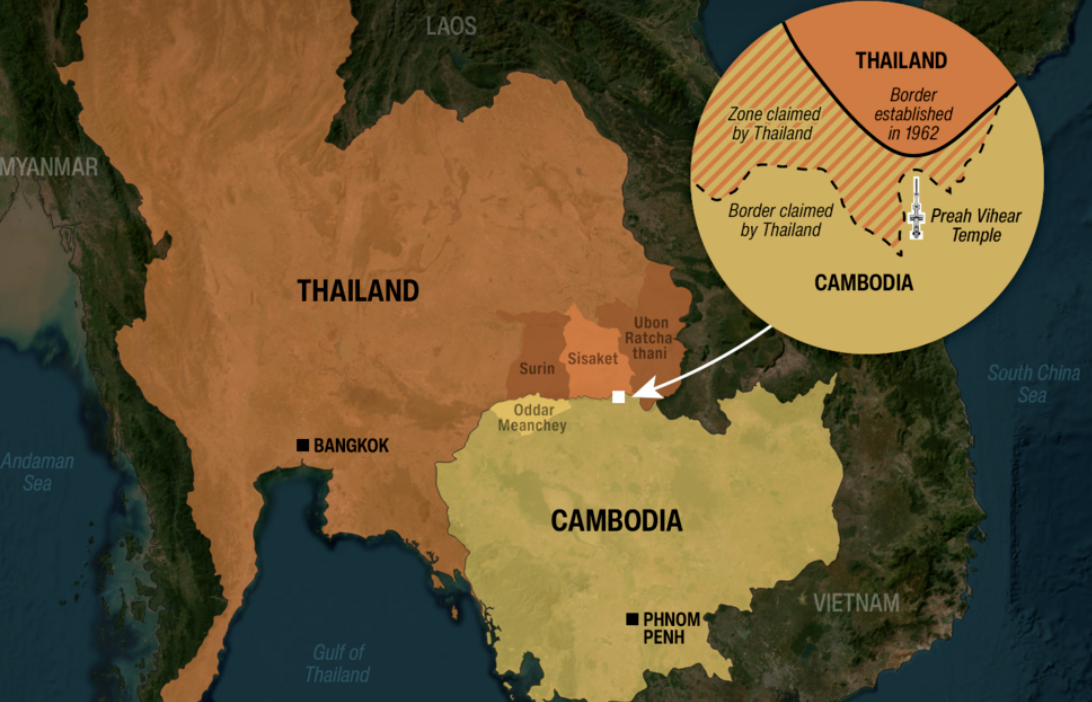
The Thailand–Cambodia border dispute originates from ambiguities embedded in the 1904 and 1907 Franco-Siamese treaties, which left multiple segments of the frontier insufficiently demarcated. Disputes surrounding the Preah Vihear Temple and adjacent areas have repeatedly escalated into armed confrontation, most notably in 2011.
These unresolved zones have evolved into permissive environments for smuggling, illicit economic activity, and periodic military friction. Over the past two decades, the border has transformed into a militarized frontier characterized by overlapping sovereignty claims, nationalist mobilization, and high operational autonomy for local military units. Confrontations have been managed episodically rather than resolved, reinforcing a pattern of frozen instability.
1.2 The Kuala Lumpur Peace Accord: Objectives and Limitations
Following renewed clashes in mid-2025, Thailand and Cambodia signed the Kuala Lumpur Peace Accord during the 47th ASEAN Summit in Kuala Lumpur, facilitated by U.S. diplomatic engagement. The accord sought to stabilize the situation through ceasefire commitments, force reductions near sensitive areas, and renewed bilateral dialogue.
From inception, however, the KLPA suffered from critical structural deficiencies:
- Absence of Enforcement Mechanisms
The agreement relies on political goodwill without verification mechanisms, compliance penalties, or third-party monitoring.
- Limited Military Ownership
Civilian endorsement was not matched by full military institutional alignment. Operational discretion remained largely intact at the tactical level.
- Ambiguity in Border Governance
Core issues—patrol protocols, mine clearance responsibilities, and rules of engagement—were deferred rather than resolved.
Crucially, the accord avoided substantive engagement with border demarcation, a zero-sum issue intertwined with sovereignty, nationalism, and control over strategic corridors. Domestic political constraints in both countries rendered compromise politically costly.
In Thailand, the military leveraged the accord period to reframe its institutional role as a regional security provider combating transnational crime. In Cambodia, Prime Minister Hun Manet and the Hun family network faced competing imperatives: defending sovereignty while managing economic interests linked to illicit networks.
The KLPA reduced tensions briefly but failed to alter underlying incentives. By early December 2025, hostilities resumed at greater intensity. Cambodia accused Thailand of indiscriminate fire into civilian areas of Pursat Province, while Thailand claimed precision strikes against cyber-scam compounds inside Cambodian territory.
2. Conflict Re-Eruption: Why Fighting Resumed
2.1 Immediate Triggers and Tactical Escalation
The renewed fighting was precipitated by a series of localized incidents including patrol confrontations, alleged mine casualties, and accusations of territorial encroachment. While such incidents are common along the border, their rapid escalation suggests a lowered threshold for force employment.
Tactical actions framed as defensive or preventive—targeted strikes, forward deployments—generated reciprocal responses, producing an escalation spiral. The absence of effective deconfliction mechanisms and persistent operational mistrust amplified this dynamic.
2.2 Structural Drivers of Re-Escalation
- Civil–Military Dynamics
Military institutions in both states retain significant autonomy. In Thailand, the armed forces continue to priorities territorial integrity and institutional credibility. In Cambodia, security forces remain embedded within ruling elite networks, reinforcing securitized responses.
- Domestic Political Incentives
Escalation serves internal purposes: mobilizing nationalism, deflecting governance pressures, and consolidating elite cohesion. Compliance with externally brokered agreements becomes secondary under such conditions.
Normalization of Low-Intensity Conflict
Decades of managed confrontation have normalized periodic violence as an acceptable risk, eroding deterrence based on diplomatic commitments alone.
2.3 Strategic Narrative Deployment
Thailand’s justification of military actions as counter-cyber scam operations constitutes a deliberate narrative strategy. It reframes force application as public security enforcement, aligns actions with international anti-crime norms, and constrains Cambodia’s diplomatic options. Whether primary or auxiliary, this narrative materially shapes international perception.
3. Cyber Scam Narrative: Law Enforcement or Strategic Cover?
3.1 Strategic Utility of the Counter-Scam Framing
Thailand’s emphasis on combating cross-border cyber scam operations constitutes a highly effective strategic narrative. By framing its military actions as part of a broader campaign against transnational crime, Thailand aligns its posture with widely shared international concerns, including cyber fraud, human trafficking, and organized criminal networks.
This framing confers several strategic advantages:
- It shifts the core discourse from territorial contestation to public security. Compared with explicitly justifying military action on the basis of territorial disputes, operations conducted under the rubric of law enforcement benefit from greater legal and political ambiguity under international law—particularly in a context where Cambodia has been accused of tolerating, or colluding with, large-scale cyber scam activities operating from its territory.
- It places Thailand on moral high ground in international opinion. Telecommunications fraud has increasingly been recognized as a global public harm, closely associated with human trafficking, forced detention, and large-scale financial crimes. By linking its actions to the suppression of transnational criminal networks and the protection of civilian rights, Thailand positions itself as responding to a humanitarian and security imperative rather than pursuing narrow strategic gain.
- The narrative complicates Cambodia’s diplomatic response. Actively defending areas widely perceived as cyber scam hubs carries significant reputational risks, constraining Cambodia’s ability to mobilize international sympathy or legal counterclaims without appearing to shield illicit activity.
Notably, this narrative has secured tacit acceptance—and in some cases understanding—from major external actors, including China, the United States, and several ASEAN member states that themselves face persistent cyber scam threats. By reframing the confrontation as an issue of transnational security cooperation rather than a conventional territorial dispute, Thailand has effectively reduced the sensitivity surrounding ASEAN’s non-interference principle and limited internal resistance to its actions.
3.2 Dual-Use Objectives and Operational Ambiguity
Cyber-scam compounds frequently coexist with Cambodian border security infrastructure. Thai strikes on these sites often coincided with precision attacks on nearby military assets, suggesting overlapping objectives: dismantling illicit operations while degrading Cambodian forward military capabilities and reshaping effective control lines.
Embedding kinetic actions within a counter-crime framework reduces escalation costs and limits international censure without formally acknowledging interstate warfare.
3.3 International Law and Sovereignty Implications
This dynamic further raises complex questions of international law and sovereignty. If such a model were to gain acceptance within the international community, it would establish a potentially destabilizing precedent, whereby states justify cross-border military operations under the pretext of combating transnational crime. Over time, these risks eroding established norms governing sovereignty and the civilian–military boundary, particularly in regions characterized by weak governance and limited border control capacity.
Under international law, the use of military force on the territory of another state without consent is strictly prohibited. Cambodia retains the legal right to raise claims of sovereignty violation before international forums, including the United Nations and ASEAN. Thailand, for its part, may seek to invoke doctrines of limited self-defense or the use of force against non-state actors. However, the scale of operations and the targeting of military assets significantly exceed thresholds typically associated with law enforcement activity.
The conflict thus exposes a broader ethical dilemma within global governance: when a sovereign state is accused of tolerating or colluding with transnational criminal networks, to what extent, if any, does this justify unilateral military action by a neighbouring state? Prevailing international practice continues to favour diplomatic engagement and law-enforcement cooperation over military intervention, reflecting a collective interest in preserving the stability of the international order.
4. Economic Dimensions and Impact Assessment
4.1 The Role of the Cyber-Scam Economy in Cambodia
While precise quantification is impossible, conservative estimates suggest Cambodia’s cyber-scam economy generates revenues in the tens of billions USD annually. Claims equating it to 60% of GDP are exaggerated, yet localized impacts are substantial.
The sector functions as a “shadow pillar” through:
- Real Estate Inflation: Laundered funds driving construction booms in Sihanoukville.
- Financial Liquidity: Underground capital flows sustaining grey financial networks.
- Corruption: Systemic collusion between operators and local authorities, eroding governance.
4.2 Impact on Thailand’s Tourism Sector
Tourism constitutes a critical pillar of Thailand’s economy and remains among the sectors most sensitive to perceptions of instability. The renewed border conflict has generated immediate and tangible disruptions across multiple dimensions of Thailand’s tourism ecosystem.
- Border Tourism Disruption:
Following the outbreak of hostilities, tourism-dependent provinces adjacent to the Cambodian border—most notably Trat Province—experienced a sharp decline in booking volumes during what is traditionally the year-end peak season. These local economies are highly reliant on short-duration leisure travel by both international visitors and domestic tourists. Heightened security concerns and travel advisories rapidly translated into cancellations, undermining seasonal revenue expectations.
- Reputational and Perception Risks:
The conflict has raised international concerns regarding regional security conditions. Several foreign governments, including the United Kingdom, issued travel advisories recommending that their nationals avoid areas within a defined radius of the Thai–Cambodian border. While geographically limited, such advisories risk generating broader reputational spillovers, potentially eroding Thailand’s long-standing image as a safe and stable tourism destination.
- Cross-Border Tourist Flow Contraction:
The escalation also disrupted outbound tourism flows, particularly Thai visitors travelling to Cambodian casinos and border cities. The suspension of cross-border travel resulted in significant losses for Cambodia’s tourism and gaming sectors, illustrating the conflict’s bidirectional economic impact and the degree of interdependence within the border tourism economy.
4.3 Supply Chain and Trade Disruption
Border closures and heightened security disrupted agricultural exports and garment supply chains. While ASEAN-wide effects remain limited, local economies dependent on cross-border trade experienced severe short-term shocks.
5. Elite Responses and Ceasefire Diplomacy
5.1 Thailand: Military Signaling and Strategic Restraint
The Thai military’s response has been characterized by controlled assertiveness—demonstrating capability and resolve while avoiding actions that would force full-scale mobilization. Public messaging emphasizes security necessity rather than territorial ambition, reinforcing the legitimacy of narrative.
Civilian leadership, meanwhile, has largely deferred to military assessments, reflecting the enduring influence of the armed forces in national security decision-making.
5.2 Cambodia: Elite Cohesion and Defensive Posture
In Cambodia, reactions from ruling elites—including networks associated with the Hun family—have prioritised regime stability and sovereignty signalling. Public statements frame Thailand’s actions as violations of territorial integrity, strongly condemn Thailand’s “aggressive” actions and accuse Thailand of firing on civilian areas, while domestically reinforcing nationalist cohesion.
At the same time, Cambodia has avoided irreversible escalation, suggesting an awareness of military asymmetry and economic vulnerability.
5.3 Backchannel Diplomacy
Despite public recriminations, evidence points to ongoing quiet diplomacy, facilitated through ASEAN intermediaries and bilateral military-to-military channels. These efforts aim less at comprehensive settlement and more at restoring tactical restraint.
In parallel, China has played a discreet but increasingly visible role in de-escalation efforts. Engagement by China’s Ministry of Foreign Affairs and designated envoys has provided both parties with an alternative communication channel outside formal ASEAN frameworks. Both Cambodia and Thailand have briefed the Chinese Foreign Minister on the evolving situation and expressed openness to China playing a “constructive role.” However, Thailand has thus far stopped short of formally accepting China as a mediator, reflecting continued sensitivity regarding third-party involvement in what it considers a bilateral security matter.
6. Major Power Involvement and Geopolitical Trajectory
6.1 United States and China: Comparative Assessment
- United States Position: Strategic Retrenchment and Regional Stability
Under the revised National Security Strategy (NSS), the Trump administration has emphasized strategic retrenchment, prioritizing the concentration of national resources on “winning the economic future” and preventing the escalation of military conflicts. Within this framework, the United States has demonstrated limited appetite for deep engagement in regional border disputes that do not directly affect major power competition.
Accordingly, Washington’s response to the Thailand–Cambodia conflict has centered on calls for restraint, adherence to international law, and support for ASEAN-led processes. This posture indicates a very low likelihood of direct U.S. military involvement in the dispute.
Nevertheless, to preserve regional influence while remaining consistent with the revised NSS, the United States is more likely to rely on indirect instruments, including behind-the-scenes mediation—such as its role in facilitating the Kuala Lumpur Peace Accord—and calibrated strategic pressure. From Washington’s perspective, the conflict represents an opportunity to test ASEAN centrality while simultaneously constraining China’s regional influence. The primary U.S. objective appears to be preventing escalation to a level that would necessitate American military intervention, while leveraging its relationships with both Thailand and Cambodia to shape outcomes aligned with U.S. strategic interests.
- China’s Position: Ally Protection and Regional Stability
China’s foremost priority is preventing escalation that could disrupt Belt and Road Initiative investments or generate broader regional instability. Despite maintaining close ties with Cambodia, Beijing has avoided overt alignment, instead favoring discreet diplomatic engagement and calibrated pressure.
As one of China’s closest partners in Southeast Asia, Cambodia occupies a significant place in Beijing’s regional strategy, supported by extensive economic engagement and military cooperation. China is unlikely to passively accept a scenario in which Cambodia faces sustained unilateral military pressure from Thailand.
China’s approach has been cautious and multi-layered. Beijing has publicly rejected allegations of arms transfers to the parties involved and has consistently characterized its role as “constructive.” Rather than direct military involvement, China is likely to rely on diplomatic mediation, economic leverage, and indirect deterrence through its security relationship with Cambodia to balance the situation. This strategy enables China to protect core interests while preserving its image as a stabilizing force in the region.
6.2 Scenario Assessment
Scenario 1: ASEAN-Led De-escalation (Medium probability)
Description:
Neither the United States nor China intervenes directly. De-escalation occurs within ASEAN mechanisms and bilateral negotiation frameworks. Thailand declares operational success following the neutralisation of key cyber scam targets, while Cambodia accepts limited forms of border security cooperation without conceding on sovereignty claims.
Likely Trajectory:
Conflict intensity declines in the short term; however, core border demarcation disputes remain unresolved. The Kuala Lumpur Peace Accord effectively becomes defunct, and the risk of future confrontation persists due to the absence of structural settlement.
Scenario 2: China-Led Balancing (Medium-High probability)
Description:
China applies sustained diplomatic and economic pressure on Thailand to halt military operations while simultaneously extending economic and security support to Cambodia. Beijing positions itself as the principal stabilising actor in managing the crisis.
Likely Trajectory:
Hostilities de-escalate rapidly, with outcomes trending in Cambodia’s favour. China’s influence over regional security affairs increases, potentially strengthening its role as a crisis manager. This, however, is likely to heighten strategic concern among the United States and its regional partners.
Scenario 3: Limited U.S. Intervention and Escalatory Complexity (Low probability)
Description:
The United States intervenes indirectly through sanctions against Cambodia—citing human rights concerns and transnational crime—or through enhanced military deployments in support of Thailand. External involvement introduces additional layers of strategic signalling.
Likely Trajectory:
The conflict risks escalation or prolonged complexity as it becomes subsumed within broader U.S.–China strategic competition. ASEAN’s centrality and capacity to manage regional security crises would face significant erosion.
6.3 Implications for ASEAN Regional Security
The conflict poses significant challenges to ASEAN’s cohesion, credibility, and regional security architecture.
- Erosion of ASEAN Centrality:
The Kuala Lumpur Peace Accord was facilitated with U.S. involvement, and the subsequent re-escalation of hostilities prompted parallel mediation efforts by both the United States and China. This sequence underscores growing doubts regarding ASEAN’s capacity and willingness to manage internal conflicts independently. ASEAN centrality—long regarded as a foundational principle of the region’s diplomatic architecture—is increasingly contested by the expanding role of external major powers in crisis management.
- Strain on the Non-Interference Principle:
Thailand’s justification of military action under the rubric of combating transnational crime has blurred the boundaries of ASEAN’s non-interference norm. If such unilateral actions are tacitly accepted, they risk establishing a precedent whereby member states invoke similar rationales to justify cross-border military operations against neighboring states. Over time, this could weaken one of ASEAN’s core normative pillars and increase the likelihood of future interstate tensions.
- Fractures in Regional Security Cooperation:
The conflict has exacerbated divisions within ASEAN, particularly undermining military-to-military trust between Thailand and Cambodia. The erosion of confidence is likely to persist beyond the immediate crisis, complicating efforts to deepen regional security cooperation and hindering progress toward greater institutional integration in the defense and security domain.
7. Policy Implications and Decision Considerations
This conflict presents a set of strategic implications for regional stakeholders rather than clear-cut policy prescriptions. The following considerations outline decision-relevant dynamics without advocating specific courses of action.
- Durability of Ceasefire Arrangements
The repeated collapse of ceasefire agreements suggests that future de-escalation efforts lacking enforcement, monitoring, and military-level buy-in are unlikely to be durable. Any renewed cessation of hostilities should therefore be assessed less as a resolution and more as a temporary risk-management measure.
Decision-makers should assume that absent structural incentive changes, tactical calm will remain reversible.
- Normalization of Transnational Crime as a Security Justification
Thailand’s framing of military actions as counter–cyber scam operations introduces a precedent with broader regional implications. If widely accepted, this approach lowers the political cost of cross-border force under the banner of transnational crime suppression.
This development may reshape norms surrounding sovereignty, law enforcement, and military jurisdiction in Southeast Asia, particularly in areas where illicit economies intersect with weak governance.
- Political Economy Constraints on Cambodian Compliance
The embeddedness of illicit digital economies within Cambodia’s local financial systems and elite patronage networks constrains the state’s ability to pursue decisive crackdowns without incurring domestic political and economic costs.
External pressure that fails to account for these structural constraints risks either superficial compliance or elite fragmentation, both of which could destabilize governance outcomes.
- Economic Risk Asymmetry Between the Parties
Thailand faces asymmetric exposure through its tourism-dependent economy, while Cambodia bears longer-term reputational and investment risks. This imbalance shapes escalation thresholds and incentives for restraint.
Economic pressure alone is therefore unlikely to produce symmetrical behavioral change.
- Implications for ASEAN and Major Power Engagement
The conflict underscores the limitations of ASEAN’s consensus-based mediation mechanisms in disputes involving core security interests. Continued reliance on declaratory diplomacy risks further erosion of ASEAN centrality.
For major external powers, the situation reinforces a preference for indirect engagement and crisis containment rather than overt intervention, consistent with broader strategic retrenchment and stability-first approaches.
8. Outlook and Strategic Implications
The Thailand–Cambodia conflict illustrates the evolving nature of interstate confrontation in Southeast Asia—where military action, illicit economies, and strategic narratives intersect. The failure of the Kuala Lumpur Peace Accord highlights the limits of declaratory diplomacy absent enforcement and elite buy-in.
Absent a structural shift in incentives, renewed ceasefires are likely to remain temporary. The most probable trajectory is neither full-scale war nor durable peace, but managed instability, punctuated by calibrated escalation and negotiation.
For regional actors and external stakeholders, the challenge lies not only in preventing violence, but in addressing the underlying political economy that sustains it.


 English
  Malay
Malay